|
|
|
|
|
|
|
Sansepolcro |
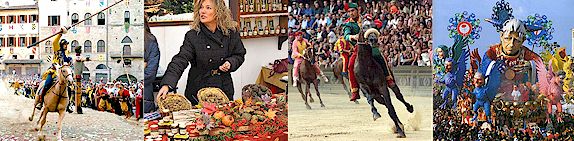
Sansepolcro is a pleasant and interesting town located on the plains of the Upper Tiber Valley, in the southeast of Tuscany, Italy, bordering Umbria and The Marches. It is worth visiting for its ambiance, for its art works, to a lesser extent for its architecture, and if possible for the Palio della Balestra (crossbow tournament) held every year on the second Sunday of September when large numbers of citizens dress in mediaeval costume and the evocative Piazza Torre di Berta becomes the site for the historical competition of the “Palio of the Ballestra”, during which the crossbow-men of Sansepolcro challenge those from Gubbio in neighbouring "Bella Umbria". In the morning, as an ancient custom requires, the Herald proclaims the challenge against the rivals. In the afternoon, after the crossbows are blessed, the crossbow-men come into the square after the flag-throwing exercise is completed. For both of these displays, Renaissance costume is worn, inspired by the paintings of Piero della Francesca. The challenge between the towns of Gubbio and Sansepolcro has very ancient origin: in a document dated 1619, the crossbow-men of Sansepolcro invite those from Gubbio to take part in the Palio of Saint Egidio on the second Sunday of September. |
Click here for a map of Sansepolcro, Italy.
|
|
|
|
|
|
|
|
Sansepolcro is situated in an area of Italy historically populated by Etruscans
whose principal cities were
Perugia, Cortona and
Arezzo (all within a
60 km radius of Sansepolcro). The Upper Tiber valley was covered in walnut trees
that were a source of timber to both Etruscans and Romans. The Romans succeeded
the Etruscans in the area and Birtugia, a Roman camp, was built where
Sansepolcro is situated today. A number of Romans, including Pliny the Younger, build their summer villas in the
Valtiberina, and Pliny praises the climate and the health of the natives in a
famous letter.
Sansepolcro was initially a fiefdom of the monastic order of the Camaldolesi but because of its important geographical position on the trade routes linking central Italy with the Adriatic, various city states have fought for control of it since the Middle Ages, beginning with the Camaldolesi (12 C), followed by Arezzo, represented by Uguccione della Faggiola (13 C) and the Signoria of the Tarlati family (14 C), passing under the power of the Ghibelline League for a short time and then in 1351 returning to the Tarlati family. In 1352 an earthquake practically destroyed the town. While rebuilding was underway, the Holy See of Città di Castello, represented by Guglielmo di Grisak, granted the town to Galeotto Malatesta, Lord of Rimini. In the 15 C, Sansepolcro was acquired by Florence, with the support of Pope Eugene IV. In the 16 C, Pope Leo X conferred upon Sansepolcro the title of City under Florentine territorial jurisdiction. In the 18C, Sansepolcro passed under the control of Duke of Lorena.
Sansepolcro is surrounded by the fertile plains of the upper Tiber valley where
tobacco is a major cash crop, and it was in Sansepolcro that Giulia Boninsegni and Gio Batta Buitoni started their production of pasta in
1827, the first pasta factory in Italy, and one of their old factories still
stands inside the town. The durum wheat used in pasta was imported mainly from
Apulia. Buitoni now belongs to Nestlé but retains a strong presence in the
area. |
|
Click here for a map of Sansepolcro, Italy.
Sansepolcro - the main sights• The Civic Museum of Sansepolcro (Palazzo della
Residenza, constructed in the 13 C and 14 C) houses four
works by Piero della Francesca. Its highlights are two of his main works: “La Resurrezione” and “La Madonna della Misecordia”.
It also houses important works by Santi di Tito and other artists mostly from churches of
Sansepolcro and the surrounding area.
|
|
|
Sansepolcro |
Sansepolcro © ammonet Web Site Promotion 2007 - 2020. All rights reserved.
)
)
)
)
)
)
)
